
Discover the main SAP Modules and their functions
Resource planning and intelligent information management are top priorities when discussing SAP modules. Discover the main functions of each one here.
If you already know or have heard of SAP, you probably also know that SAP Modules are fundamental components, as they allow a company to manage databases from different processes and areas within a single, unified system.
To understand what this means in practice, a survey conducted by SAP itself identified that S/4HANA helped achieve significant results, such as:

Figures like these are important to illustrate how significant post-implementation changes are, and for this reality to be possible, the modules play a fundamental role. With the help of SAP modules, an organizational structure's processes will be unified and operate effectively.
Discover the greatest benefits of S/4HANA by accessing this blog content.
According to research conducted by StrategicCFO360 and SAP, 71% of participating CFOs believe they are ahead of the curve in terms of openness to change with technology systems, while only 5% consider themselves laggards. But perhaps more surprising is their role in corporate technology decision-making over the past year, with 64% saying their influence has increased.
As CFOs continue to drive digital investments across the enterprise and add value through their own transformation, some financial organizations are evolving into full-fledged business service centers.
To make this innovative reality possible, integrating internal organizational information, using a single source of truth, enabling real-time processes, dynamic planning, and instant information, SAP has developed customized modules for the needs of each area.
What are the available SAP Modules?
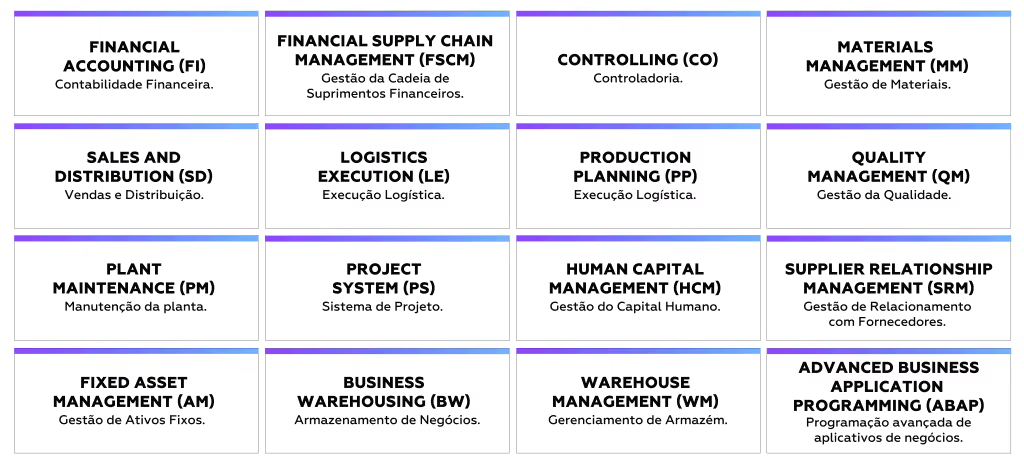
Now that we've introduced the main SAP modules and their functions, let's take a closer look at which ones are most used and how they operate individually. Understanding the objective of each module is important so you can plan and choose those that best suit your company's needs. When it's time to customize your SAP, all aspects must be covered, and for that, it's important to understand each one. See below:

Sales and Distribution (SAP SD)
SAP SD is one of the most important modules of the SAP – with a high level of integration complexity. Organizations use SAP SD to support sales and distribution activities for products and services, from order initiation to final delivery.
SAP SD can monitor many activities that occur within the organization, such as product inquiry, quotation (pre-sales activities), order management, pricing, delivery planning (sales activities), picking, packing, goods issue, shipping products to customers, product delivery, and collection.
Several modules are involved in all these processes, such as FI (Financial Accounting), CO (Controlling), MM (Materials Management), PP (Production Planning), LE (Logistics Execution).
Financial Accounting (SAP FI)
The financial accounting module is responsible for tracking the flow of financial data throughout the organization in a controlled manner and integrating all information to make effective strategic decisions. In this regard, the SAP FI module includes various activities, such as creating an organizational structure, global financial accounting settings, accounts payable, and accounts receivable.
Controlling (SAP CO)
The SAP CO module helps coordinate, monitor, and optimize all organizational processes. To achieve its objective, the SAP CO module includes several functions: cost element accounting, cost center accounting, activity-based costing, product cost controlling, profitability analysis, and profit and loss assessment across various independent areas of the organization.
Materials Management (SAP MM)
The SAP MM module handles material movement within the organization, including logistics, supply chain management, sales and delivery, warehouse management, production, and planning activities.
Supplier Relationship Management (SAP SRM)
The SRM module manages supplier relationships. That is, it deals with the effective exchange of products and services between the organization and its suppliers. The main process addressed in this section is the procurement of products such as direct materials, indirect materials, and services. This module can be effectively integrated with planning, accounting, and inventory systems.
Human Capital Management (SAP HCM)
The SAP module also includes HCM, which contains human resources-related activities. In this module, employee-related data is entered for management, time recording, and payroll purposes.
The HR system has a very powerful integration point with almost all other SAP modules (data can be transferred without manual intervention). Furthermore, there is a very close integration between the HR sub-modules.
Production Planning (SAP PP)
The SAP PP module is intended for production planning and management. It is used in conjunction with sales, so that sales and operations planning, distribution resource planning, material requirements planning, product cost planning, etc.
Quality Management (SAP QM)
The SAP QM module helps organize product quality management within the process. This is very useful for organizations to accelerate business development – by using a structured and functional approach to manage quality across different processes.
To achieve its objective, the quality management module has been integrated with several other processes: procurement and sales, production, planning, inspection, notification, control, audit management, etc.
Plant Maintenance (SAP PM)
The SAP PM module manages all maintenance activities within an organization. In fact, we're talking about a series of key activities, including inspections, notifications, corrective and preventive maintenance, repairs, and other measures to keep the technical system optimal.
Advanced Business Application Programming (SAP ABAP)
Finally, we have SAP ABAP, which stands for Advanced Business Application Programming. It represents the most widely used development language in SAP.
See also: 1st Market Research on S/4HANA in Brazil

Do you want to leverage all the possibilities each module can offer your company? Upgrade to S/4HANA and discover endless ways to optimize your operations!
To ensure the most efficient, fastest, and most innovative S/4HANA conversion project on the market (and we mean it!), choose MIGNOW, the only software on the market capable of automating migration and keeping you up-to-date with SAP's latest releases.
Did you like this content about SAP Modules?
See more content about S/4HANA here, or contact our sales team for personalized service here.
SAP AI: Joule and the Future of ERP Technology
Do you know how SAP AI, Joule is going to bring the future of ERP experience. In this post we talk about how this is already happening.

A New Frontier Marked by SAP: AI is the Name of the Game Now
Artificial Intelligence (AI) is no longer a futuristic vision. Today, it is the frontier transforming the present and shaping the future of business, especially when combined with the power of SAP S/4HANA. Large corporations are already achieving surprising results by integrating AI into their processes, reaching new levels of efficiency, innovation, and competitiveness.
SAP's Quantum Leap: 10 Reasons to Migrate to S/4HANA Now
SAP S/4HANA is revolutionizing businesses, offering a transformative leap forward. With SAP ECC support ending in 2027, migration is essential to ensure operations remain secure and efficient. Let's explore the main reasons for making this change and how it can positively impact businesses.